AI Medical Diagnosis: Less Keyboard Time, More Patient Time
Author: /
Released:December 5, 2025
Still drowning in charts while missing critical diagnostic clues? You’re likely losing thousands in "hidden" administrative drain. While peers are leveraging AI medical diagnosis to reclaim their evenings and boost accuracy, many are still stuck in the 2010s. Here is how to stop overpaying for inefficiency today.
Why Your Clinic is Leaking Cash
The average physician spends nearly two hours daily on documentation alone [1]. If your time is valued at $150/hour, that is $300 a day—or roughly $70,000 a year—spent on typing instead of treating.
Enter the AI medical scribe. By automating clinical notes in real-time, these tools aren't just "neat tech"—they are high-yield financial assets. Early adopters in 2025 are reporting a 3.2X return on investment within 14 months by increasing patient throughput and virtually eliminating "after-hours" charting [2].
1. The "Second Brain": AI for Medical Diagnosis
Modern AI for medical diagnosis has evolved beyond simple pattern matching. Today’s platforms analyze imaging and lab results to flag anomalies—like lung nodules or early-stage fractures—with accuracy rates often exceeding 90%, significantly higher than the human-only baseline in high-pressure settings [3].
For a busy clinic, this is the ultimate "safety net." It catches the subtle 10% of cases that fatigue might miss. Think of it as a specialized AI medical helper that never sleeps and has read every medical journal published in the last decade. It doesn't replace your judgment; it gives you a data-backed head start.

2. The "Administrative Ghostwriter": AI Medical Scribe
The most immediate "profit hack" in 2026 is the AI medical scribe. Tools like Sunoh.ai and Heidi Health listen to patient encounters and generate structured clinical notes instantly.
- The ROI: Doctors report saving over 2 hours per day.
- The Clinical Edge: You can finally maintain eye contact with your patient instead of staring at a screen.
- The Billing Win: AI-driven notes are often more comprehensive, reducing claim denials and ensuring accurate coding for maximum reimbursement.
Official Sites to Compare:
- Sunoh.ai– Trusted by over 90,000 providers for seamless EHR integration.
- Heidi Health– A favorite for specialty-specific automated care plans.
- Glass Health– Ideal for real-time diagnostic insights and evidence-based clinical reference.
Where the Money Is: AI Medical Helper vs. Manual Labor
When evaluating AI medical solutions, don't look at the subscription cost—look at the opportunity cost.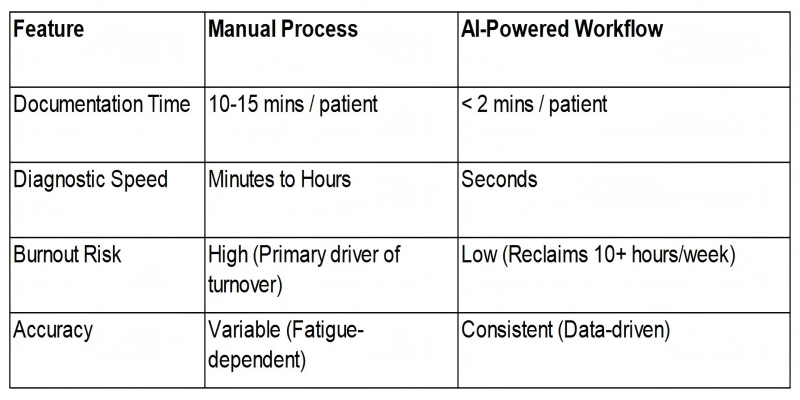
The real "steal" isn't in finding the cheapest software; it’s in finding the one that integrates with your existing Electronic Health Record (EHR). Platforms that "talk" to your billing software can automatically suggest the correct ICD-10 or HCC codes, adding an estimated $7,000 in annual revenue per physician through better capture of patient complexity [1].
The Reality Check: Don't Get Fooled by the Hype
Not every tool labeled "AI medical" is worth your budget. Smart managers are avoiding "generalist" AI in favor of Hyper-Vertical solutions. If a tool claims it can "diagnose everything," it’s likely a liability.
The gold standard in 2026 is the Human-in-the-Loop model. The AI provides the draft; the doctor provides the final sign-off. This maintains clinical responsibility while stripping away the manual labor. If you’re looking at AI for medical diagnosis, ensure it provides "traceability"—meaning it links its suggestions back to peer-reviewed sources like the NIH or Lancet.
Conclusion
We are past the "wait and see" phase. By the end of 2025, over 85% of healthcare organizations reported a moderate-to-high ROI from AI implementations [4]. The gap between AI-enabled clinics and traditional ones is no longer just about "prestige"—it’s about financial survival.
Whether you start with a simple AI medical helper for clinical references or go full-scale with an integrated AI medical scribe, the goal is clear: do more of what you were trained for and less of what the machine can do better.
You don't need a massive IT budget to start. Many of the top-tier scribing and diagnostic tools offer "freemium" tiers or per-user pricing that pays for itself within the first week of use. It’s time to stop paying the "manual labor tax" and start reaping the rewards of the most efficient era in medical history.
Explore the latest platforms, compare their EHR compatibility, and see which clinical "co-pilot" fits your specialty's unique rhythm. Your time—and your bottom line—are worth the upgrade.
Reference
[1] AI Scribes: A Framework for Evaluating ROI
[2] Proven Frameworks Driving 3.2X ROI in Healthcare AI
[3] AI Diagnostics: Revolutionizing Medical Diagnosis in 2026
[4] AI in Healthcare 2025 Statistics: Adoption & Impact